| |
|
| |
about |
|
| |

Sikiru
Adepoju |

Sikiru
with Babatunde Olatunji |

Sikiru
Adepoju - LIVE |
|
The man whom former Grateful Dead drummer Mickey Hart
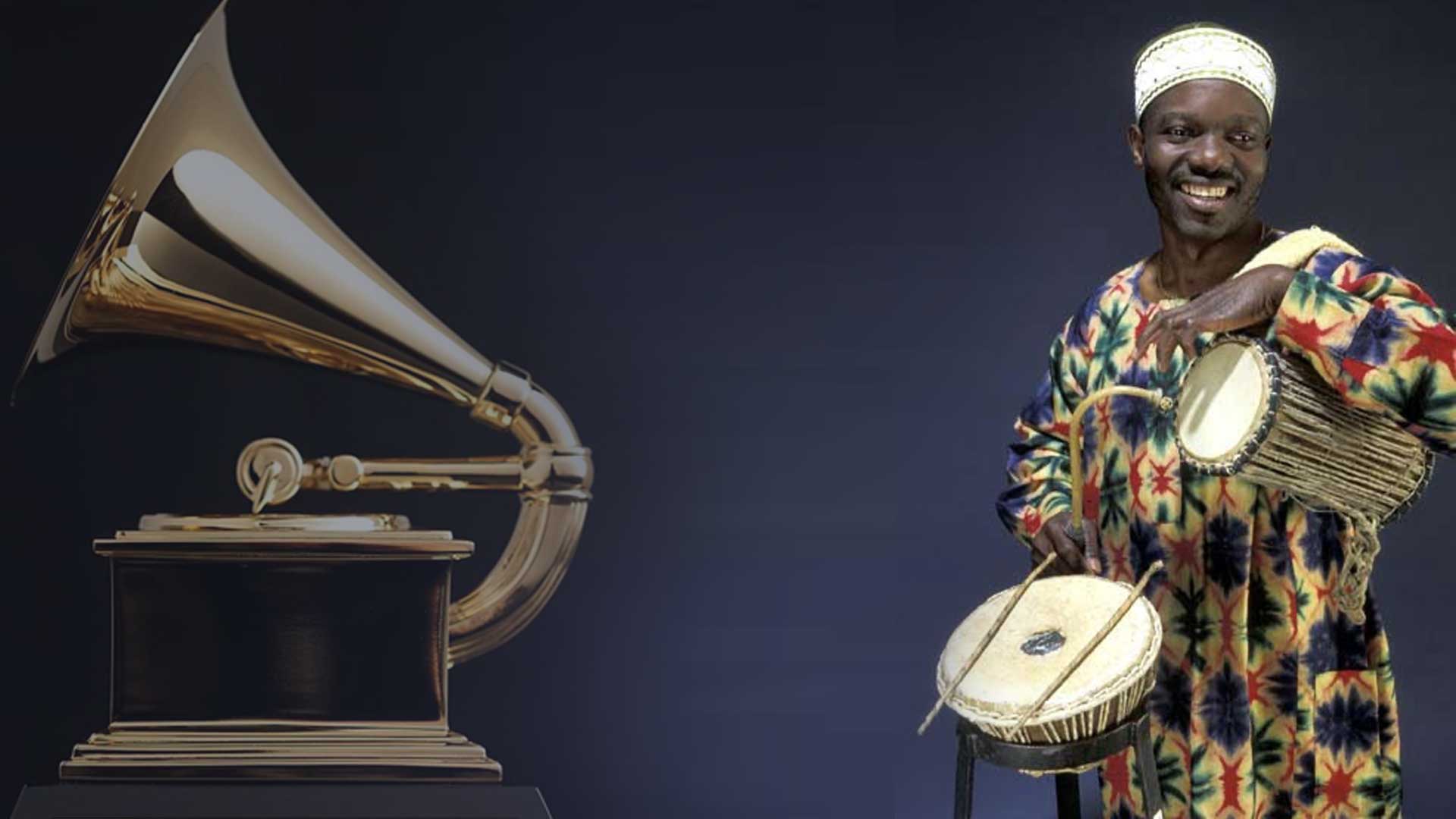
calls "the Mozart of the talking drum," Sikiru
Adepoju (Seek-ee-roo Ah-deh-poh-joo), first came
to the focus of the American music scene through his involvement
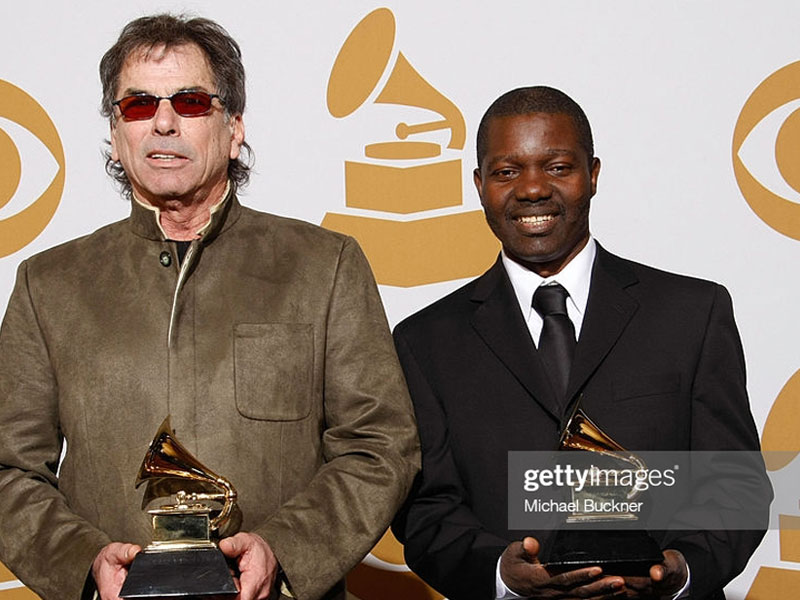
with Hart in the Grammy Award winning Planet Drum project.
His technical mastery of the talking drum and various
indigenous percussion instruments (dundun, gudugudu, gome,
omele, sekere, etc.) have gained acceptance and respect
among music listeners of all tastes. Yet, it is his unique
spirit, discipline, and commitment to the moment that
have gained him respect among his musical peers, and have
contributed to his ability to engage and draw in audiences,
body & mind, all the over globe.
Born
in Eruwa, Western Nigeria, Sikiru grew up in a "talking
drum family" where he began his tutelage of the instrument
at his father's side, at the age of six years old. He
then went on to tour and record several albums with renowned
Nigerian Juju artist Chief Ebenezer Obey
and his Inter-Reformers Band. Obey, who called his personal
style the miliki (enjoyment) sound, began where noted
juju entertainer I.K. Diaro left off. Obey drew in such
Western elements as multiple guitars and a Hawaiian steel
guitar soloist, adding them to the traditional rhythmic
foundation.
Through
his work with Obey, and subsequent work as a studio musician
in Nigeria, the young Sikiru quickly won himself appreciation
as a leading force on the talking drum throughout his
homeland. In 1985, rising afrobeat artist, and nephew
of I.K. Dairo, O.J. Ekemode, approached
Sikiru to join his band. Sikiru agreed & later the
same year Ekemode brought Sikiru and several other musicians
from Nigeria to the United States to record and tour.
After
he moved to the Bay Area in 1985, Sikiru, soon met world-renowned
percussionist and leading African music artist Babatunde
Olatunji. Shortly after meeting Olatunji, Sikiru
joined his Drums of Passion ensemble and began a 17 year
period of productivity with the group, recording &
touring extensively throughout the world, until a year
before Olatunji's death in 2003.
While
a member of Olatunji's Drums of Passion, Sikiru recorded
with Stevie Wonder, & Carlos Santana, and performed
with the Grateful Dead, where he met Grateful Dead drummer
Mickey Hart. It was after meeting Hart
that Sikiru also joined Hart's Planet Drum
ensemble to record & tour. In 1991 the group's debut
release "Planet Drum" hit #1 on the Billboard
World Music Chart, remaining there for 26 weeks, and went
on to receive a Grammy Award for Best World Music Album.
In 2002 Sikiru joined Mickey Hart's Bembe Orisha
(party to the spirits), where he continues to tour &
perform.
In
2003 Sikiru joined Trinidad born steel pan wizard Val
Serrant to create Afrika Heartbeat.
Afrika Heartbeat melds the musical influences of Yoruba
culture across the African Diaspora with a foundation
in Nigerian Juju music and Highlife.
|
SIKIRU
ADEPOJU
&
AFRIKA HEARTBEAT |

Afrika
Heartbeat Logo |

Sikiru
Adepoju & Afrika Heartbeat |

Sikiru
Adepoju & Afrika Heartbeat - LIVE |
|
What do you get when you put together seven world-class
musicians with resumes that include playing/recording
with the Grateful Dead, Babatunde Olatunji, Dizzy Gillespie,
and Stevie Wonder? You get Sikiru Adepoju & Afrika
Heartbeat. This amazing 7-piece West African Juju music
& Highlife ensemble consists of Sikiru Adepoju
(talking drum), Val Serrant (vocals &
percussion), Nengue Hernandez (percussion),
Peter Fuji (guitars), Deszon
Claiborne (drums), Bola Abimbola
(vocals), and Danjuma Adamu (bass). Each
member of Afrika Heartbeat is a seasoned artist with reputations
worthy of individual praise, and together, they are receiving
it.
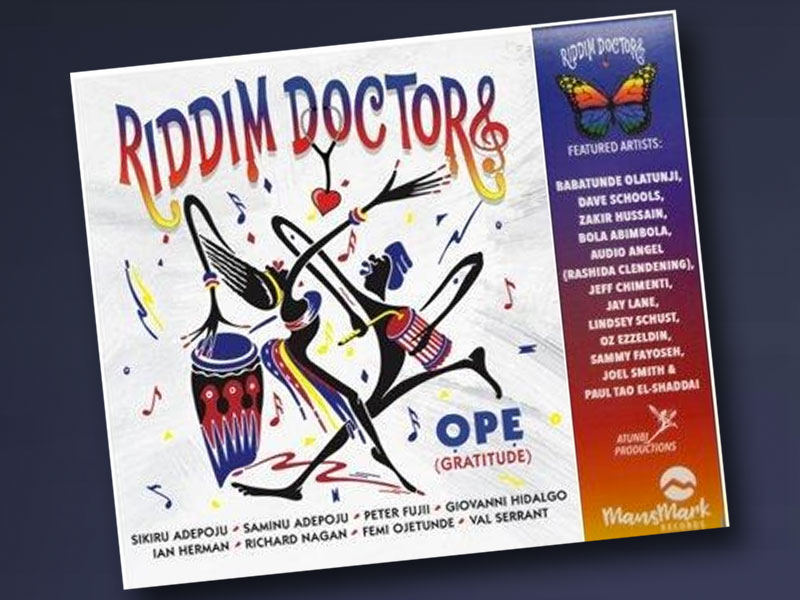
With the release of their debut CD earlier this year,
"Ijinle Ilu" (Original Drumming),
they are capturing the hearts of world music DJs &
jamband aficionados alike with their ability to draw out
hypnotic rhythms which find their origins rooted in the
Juju music & Highlife of the Yoruba cultural region
of Nigeria. But their music doesn't stop there. Their
unique blend of percussion-based music spans the African
diaspora to include Yoruba-influenced folkloric music
of Latin America and the Caribbean, along with jazz and
R&B, and makes any show with Sikiru Adepoju &
Afrika Heartbeat something to see! Recalling some of the
artists with whom the members of Sikiru Adepoju &
Afrika Heartbeat have recorded or shared the stage, reads
like a "who's who" of the Jamband/Jazz/World
music scenes: Mickey Hart's Planet Drum, Jerry Garcia,
King Sunny Ade, Airto Moreira, Ornette Coleman, Zakir
Hussain, Pharaoh Sanders, Carlos Santana, the Grateful
Dead, Olatunji's Drums of Passion, Pele Juju, the String
Cheese Incident, The Radiators, and many more.
Do yourself a favor: Go see Sikiru
Adepoju & Afrika Heartbeat!
|
MICKEY
HART
&
BEMBE ORISHA |

Mickey
Hart |

Bembe
Orisha |
|
"World music is culture specific," says Mickey
Hart, the former Grateful Dead drummer, ongoing
ethnomusicologist and leader of Bembe
Orisha. "If you were in the Philippines
and you heard music of Appalachia, you would consider
that world music, or vice versa. So 'world music' really
isn't a good term to describe anything. It's the world's
music."
"'Bembe Orisha' means party to the saints, the spirits
of nature," he says. "It's a West African word.
So that's what this is all about. It honors the roots
of the music that we got -- rock 'n' roll, blues, big
band, jazz. It all came to us from Africa. This is the
roots of the roots."
Bembe Orisha features musicians from all over the world
playing native instruments. It includes Nigerian percussionist
Sikiru Adepoju; two Cubans, vocalist
Bobi Cespedes and Nengue Hernandez
on Latin percussion and vocals; Persian vocalist Azam
Ali; South African bassist/vocalist Bakhithi
Kumalo; and guitarist Barney Doyle
and drummer Greg Ellis, both from the
U.S. In Bembe Orisha, Mickey Hart mans a drum set, a balaphon,
a thumb piano called a kalimba, and his electronic master,
RAMU (Random Access Musical Universe), which allows him
to call up any of a zillion pre-programmed sounds.
|
MICKEY
HART'S
PLANET
DRUM |

Planet
Drum album cover |
|
"It had long been a dream of mine to bring together
great drummers from around the world to make a recording
based entirely on percussion," said Mickey
Hart. In 1991, that dream became reality when
Hart enlisted the talents of world-renowned percussionists
Zakir Hussain, Airto Moreira,
Babatunde Olatunji, Giovanni
Hidalgo, Sikiru Adepoju, and
vocalist/percussionist Flora Purim to
record and ultimately extensively tour the project that
became known as Planet Drum.
Planet Drum's self-titled album not only hit #1 on the
Billboard World Music Chart, remaining there for 26 weeks,
it also received the Grammy for Best World Music Album
in 1991 (the first Grammy ever awarded in this category).
Planet Drum is one of twenty-nine recordings released
on Mickey Hart's the WORLD series on Rykodisc.
|

Babatunde
Olatunji |

Babatunde
Olatunji & Sikiru |

Giovanni
Hidalgo, Babatunde Olatunji,
Mickey
Hart, Sikiru Adepoju (L-R) |

Babatunde
Olatunji & Sikiru (background) |
|
|
Late Nigerian drummer Babatunde
Olatunji pioneered the successful introduction
of native African music to US popular music culture and
influenced musicians such as Carlos Santana, Mickey Hart,
John Coltrane and Bob Dylan.
Released in 1960, his groundbreaking album, "Drums
of Passion," is considered the first significant
album in the so-called "world music" genre in
the United States. It has sold more than 5 million copies.
"Baba" Olatunji is best known to San Francisco
Bay Area rock fans through his association with the Grateful
Dead. His Drums of Passion performance group, which also
featured Sikiru Adepoju, appeared in concerts with the
Dead. Olatunji was also a founding member of Grateful
Dead drummer Mickey Hart's Grammy-winning Planet Drum
ensemble of world percussionists.
"He was the first to bring African rhythms to western
music, to rock 'n' roll and jazz," Hart has said.
"He changed the face of what we recognize as music."
For more than 40 years, Baba Olatunji served as an unofficial
ambassador of African music and culture, teaching traditional
drumming, dancing and chanting. Coltrane, the great jazz
saxophonist, was among those who studied at his Olatunji
Center for African Culture in Harlem.
Santana recorded Olatunji's song "Jingo," and
titled one of his albums "Shango," a track from
Olatunji's landmark "Drums of Passion" record.
Dylan mentioned him on his classic 1963 album "The
Freewheeling Bob Dylan," singing "What I want
to know, Mr. Football Man, is what do you do about Martin
Luther King, Willie Mays, Olatunji?"
A prominent voice during the civil rights movement, Baba
Olatunji performed at President John F. Kennedy's inauguration.
He also is credited with being an early proponent of the
mind-body-spirit connection in music therapy, seeing drumming
as a way to physical, spiritual and emotional health.
He once said, "Rhythm is the soul of life. The whole
universe revolves in rhythm. Everything and every human
action revolves in rhythm."
|
|
|
|
|
|